
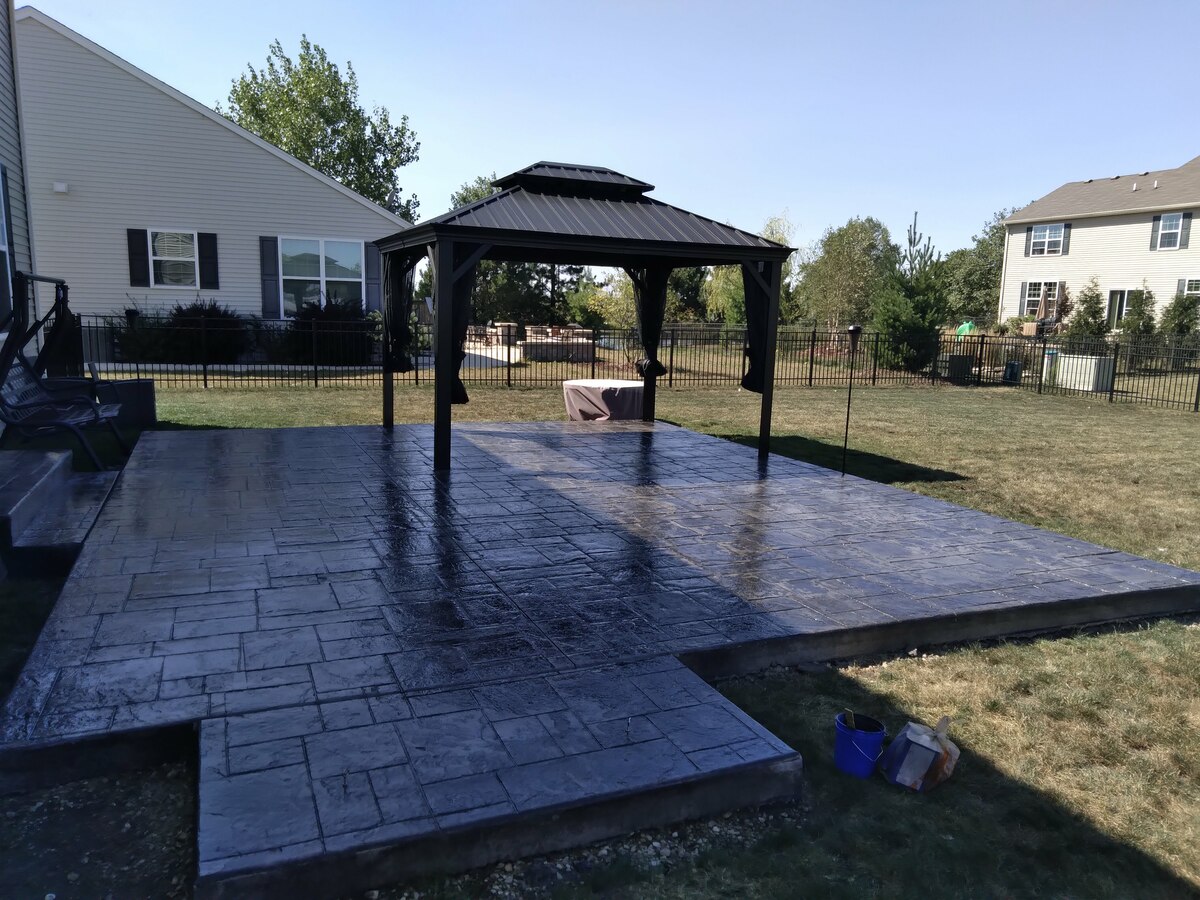
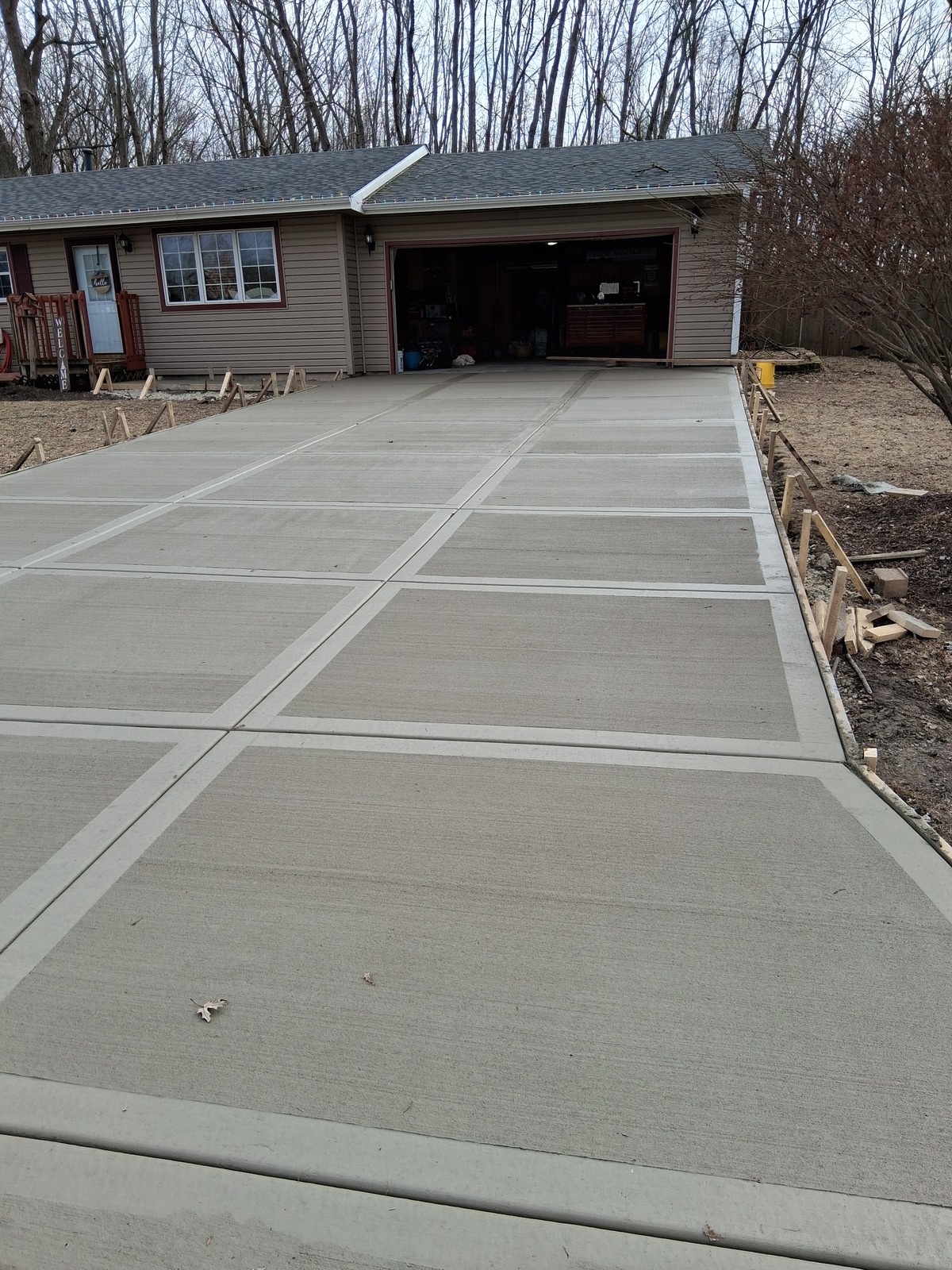
Driveways & Walkways
Clean lines, a proper base, built for daily traffic.
Garage & Basement Floors · Joliet & Chicagoland
Garage slabs that shed water and stand up to road salt, and basement floors set over the right layers underneath. Poured and finished by one crew across Joliet and Chicagoland.
Source: Illinois Admin. Code
What's included
Two slabs, poured smooth and level and built for what sits on them.
Garage slabs pitched to drain and built to carry vehicles.
Basement slabs poured level over the layers that belong underneath.
Compare
They look alike. What they face, and what goes under them, is not.
| Garage floor | Basement floor | |
|---|---|---|
| What it faces | Road salt dripping off cars, freeze-thaw at the door, and vehicle weight. | Ground moisture and soil gas from below. |
| What goes underneath | A compacted base. The residential code doesn't require a vapor retarder under garage slabs. | In new Illinois homes: at least 4 in. of clean gravel, then 6-mil sheeting lapped at least 12 in. |
| The detail that matters | Slopes toward the door or a drain so water and melted snow run out. | Floor openings and joints sealed with polyurethane caulk in new homes. |
Garage floor
Basement floor
Sources: Illinois Admin. Code · Fine Homebuilding · Building Code Trainer
Replacing a floor in an existing home? We'll look at what's under it at your free quote visit.
How we build it
Both floors start below the surface. Here's the order.
The subgrade is graded and compacted. Soft spots come out so the slab sits on an even bed.
Source: Concrete Network
The layers under the slab go in before the pour. In new Illinois homes, code calls for at least 4 in. of clean gravel under basement slabs, topped with 6-mil sheeting lapped 12 in.
Source: Illinois Admin. Code
Garage floors are pitched toward the door or a drain, and control joints are planned before the pour.
Source: Fine Homebuilding (IRC R309.1)
Poured, leveled, and finished smooth by the same crew that prepped it.
Cured before traffic. In cold weather, Joliet requires flatwork to be kept at 55°F for at least five days.
Source: City of Joliet
One crew from the base to the final finish.
The standard
From Illinois code, the City of Joliet, and NRMCA. Ask any contractor for theirs.
New Illinois homes get at least 4 in. of clean gravel under the basement slab, a layer that lets soil gas be vented from under the whole floor.
Source: Illinois Admin. Code
Over the gravel goes 6-mil sheeting, lapped at least 12 in., as a soil-gas retarder.
Source: Illinois Admin. Code
Joliet allows flatwork at 32°F and rising, with the concrete protected at 55°F for at least 5 days.
Source: City of Joliet
Where deicers reach concrete, like salt dripping off cars in a garage, NRMCA calls for at least 4,000 psi.
Source: NRMCA
Care
Salt that drips off cars in winter is still deicer. Rinse it off the garage floor, especially in the first year.
Source: NRMCA
Keep mats and storage off the route to the door or drain, so water keeps running out.
A penetrating silane or siloxane sealer helps protect against salt and freeze-thaw.
Source: NRMCA
In new homes, openings and joints in the basement floor are sealed with polyurethane caulk. Reseal any that open up.
Source: Illinois Admin. Code
Yes. Under the residential code, the parking area slopes toward a drain or the main garage door so water and melted snow run out.
Source: Fine Homebuilding (IRC R309.1)
The residential code exempts garages and other unheated accessory structures from its vapor retarder rule. Basement and living-space slabs are a different story.
For new homes, Illinois requires:
Source: Illinois Admin. Code
Joliet's rule for flatwork: the air has to be at least 32°F and rising, and the concrete must be protected to stay at 55°F for at least five days.
Source: City of Joliet
Salt that drips off cars is deicer, and deicers drive scaling, especially on new concrete. NRMCA calls for at least 4,000 psi where deicers reach the slab, and no deicers in the first year.
Source: NRMCA
Yes. New garages need an approved concrete foundation and a permit with an accurate plat of survey.
Source: City of Joliet
Under the residential code, living-space slabs sit on a 6-mil vapor retarder that limits moisture coming up through the floor. Water coming in through walls or cracks is a waterproofing and drainage question, which is a separate specialty.
Get started
Request a free quote and we'll look at the space, what's underneath, and how water needs to move, then walk you through options and timeline. Prefer to talk? Call 815-836-1828, 7 days a week.
Free quotes, 7 days a week.